Legal Documents That PeopleCan Actually Understand
Combining AI and evidence-based plain-language principles to improve comprehension without compromising legal accuracy.
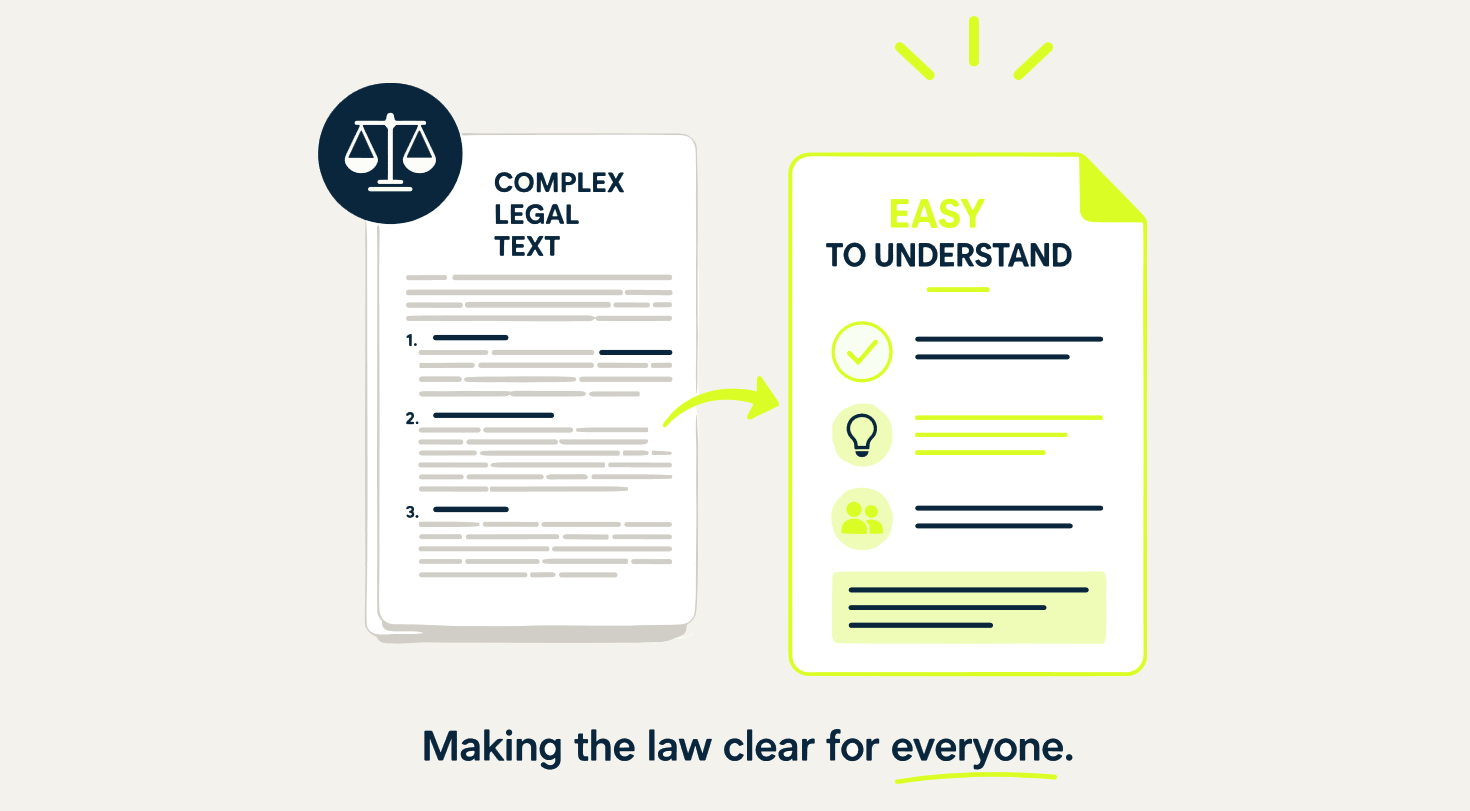
Context
Contracts, terms and conditions, legal notices and other legal documents are designed to protect the parties who agree to them and define their obligations. Yet the use of technical jargon often makes these documents particularly difficult to understand for their intended readers, who are mainly non-lawyers.
This creates a paradox that directly undermines their effectiveness.
The Challenge
The challenge is to rewrite legal texts from the reader’s perspective, adapting their vocabulary and formulations without weakening their legal effect.
Although established frameworks exist, including ISO 24495-1 and the work conducted by COSLA, applying plain-language principles consistently in day-to-day legal drafting remains a significant challenge.
The Solution in a nutshell
An AI bot that transforms legal documents into clearer, better-structured and easier-to-use versions while preserving their legal effect.
The transformation process is based on six key stages:
- Understand the readers: identify their level of knowledge, reading context and objectives.
- Analyse the document: identify information that is missing, ambiguous, poorly prioritised or difficult to understand.
- Make information easier to find: reorganise the content so that readers can quickly locate the information that is relevant to them.
- Simplify the drafting: use familiar words, direct sentences and explicit logical connections.
- Preserve legal accuracy: retain and explain essential legal terminology without changing any rights, obligations, conditions, deadlines or consequences.
- Review the final version: compare the transformed document with the source text to verify its completeness and accuracy.
The solution relies on a plain-language drafting guide, a legal reformulation glossary and a review protocol designed to govern and secure every transformation.
See below for more details
Value Created
Within minutes and with no additional effort, you receive a document in which readers can quickly find the relevant information, understand it, know how to use it and complete the expected actions, without undermining the legal effect of the original text.
Step 1: Consider the Document’s Intended Reader
During the first stage, the bot identifies the document’s intended reader by considering the following questions:
- Who are they?
- What is their level of proficiency in the language and their knowledge of the subject?
- In what context, including their emotional context, will they read the document?
- What are their expectations and objectives?
This is a crucial stage because it determines the entire transformation process. The document must then be written from the reader’s perspective and according to their needs, while preserving its legal effect.
Step 2: Ensure the Relevance of the Information
The bot analyses the document to determine whether any relevant information that the target audience could reasonably expect is missing.
It then prioritises the information contained in the document according to the reader’s expectations. Certain information may be highlighted, while other content may be removed, provided that its removal does not produce any legal consequences.
Step 3: Improve Understanding and Readability
The bot reorganises and rewrites the document by addressing:
- information that is difficult to find or poorly prioritised;
- legal or technical terms that are not sufficiently explained;
- long, abstract or ambiguous sentences;
- actors and responsibilities that are not clearly identified;
- conditions, exceptions, deadlines or consequences that are not sufficiently visible;
- missing information required for understanding or taking action.
To perform this work, the bot applies structured drafting rules inspired by COSLA’s work and uses a legal terminology glossary that recommends either a clearer reformulation or a definition to be included in the document.
Step 4: Verify the Legal Effect of the Document
Finally, the transformed version is compared with the source document to ensure that no right, obligation, deadline, amount, condition, exception or consequence has been modified or removed.
Where necessary, further adjustments are made before the final version is produced.